Transponder Key vs Smart Key: What Is the Difference?
Transponder key, smart key, proximity fob, remote head key — what do these terms actually mean? A Vancouver WA locksmith explains the differences and what replacement involves for each type.

Transponder Key vs Smart Key: What Is the Difference?
When you call a locksmith or search online for car key replacement, you will run into terms like transponder key, smart key, proximity fob, remote head key, and flip key. These are not interchangeable — each refers to a different technology, and the type of key your vehicle uses directly affects what replacement involves and how long it takes.
Here is a plain-language explanation from a locksmith who programs all of these in Vancouver WA every week.
The Basic Principle: All Modern Car Keys Have Two Jobs
A modern car key does two things:
- Mechanically — it turns the ignition cylinder (or, on push-to-start vehicles, it does not need to at all)
- Electronically — it communicates with the vehicle's immobilizer to authorize the engine to start
The electronic part is what separates modern keys from the simple metal keys used before the mid-1990s. If the electronic signal is missing or wrong, the car will crank but not start — even if the blade is cut perfectly.
Transponder Keys
A transponder key looks like a regular metal key, but the plastic head contains a small RFID chip. When you insert the key and turn the ignition, the car's antenna ring reads the chip. If the chip ID matches what is stored in the ECU, the immobilizer disarms and the engine starts.
How to identify one: The key head is usually thicker than a basic metal key, often with a black or gray plastic housing. There is no battery — the chip is passive and powered by the car's antenna ring.
Common vehicles: Many Honda, Toyota, Ford, Chevrolet, and other domestic and import vehicles from the late 1990s through the mid-2010s used basic transponder keys — though the exact years and trims vary widely by make and model. Call us with your year, make, and model and we can confirm what your vehicle uses.
Replacement process: Cut the blade to the correct code, then program the chip to the vehicle's ECU using a professional programmer. Takes 15–45 minutes on-site.
Remote Head Keys
A remote head key is a transponder key with integrated remote buttons (lock, unlock, trunk, panic) built into the key head. The remote function uses a separate RF transmitter — it is not the same as the transponder chip.
How to identify one: Larger plastic head with visible buttons. Has a battery (usually CR2032) for the remote function.
Common vehicles: Dodge Ram, Jeep Wrangler, Chrysler 300, many GM trucks and SUVs from the 2000s and 2010s.
Replacement process: Cut the blade, program the transponder chip to the ECU, and sync the remote to the vehicle's receiver. Two separate programming steps.
Flip Keys (Folding Keys)
A flip key is a remote head key where the metal blade folds into the fob housing when not in use. Press a button and the blade flips out. Same electronics as a remote head key, just a different physical form factor.
Common vehicles: Many Dodge, Jeep, Chrysler, and GM trucks and SUVs from the 2000s and 2010s used flip keys — though the exact years and trims vary. Call us with your year, make, and model to confirm.
Smart Keys (Proximity Fobs / Push-to-Start)
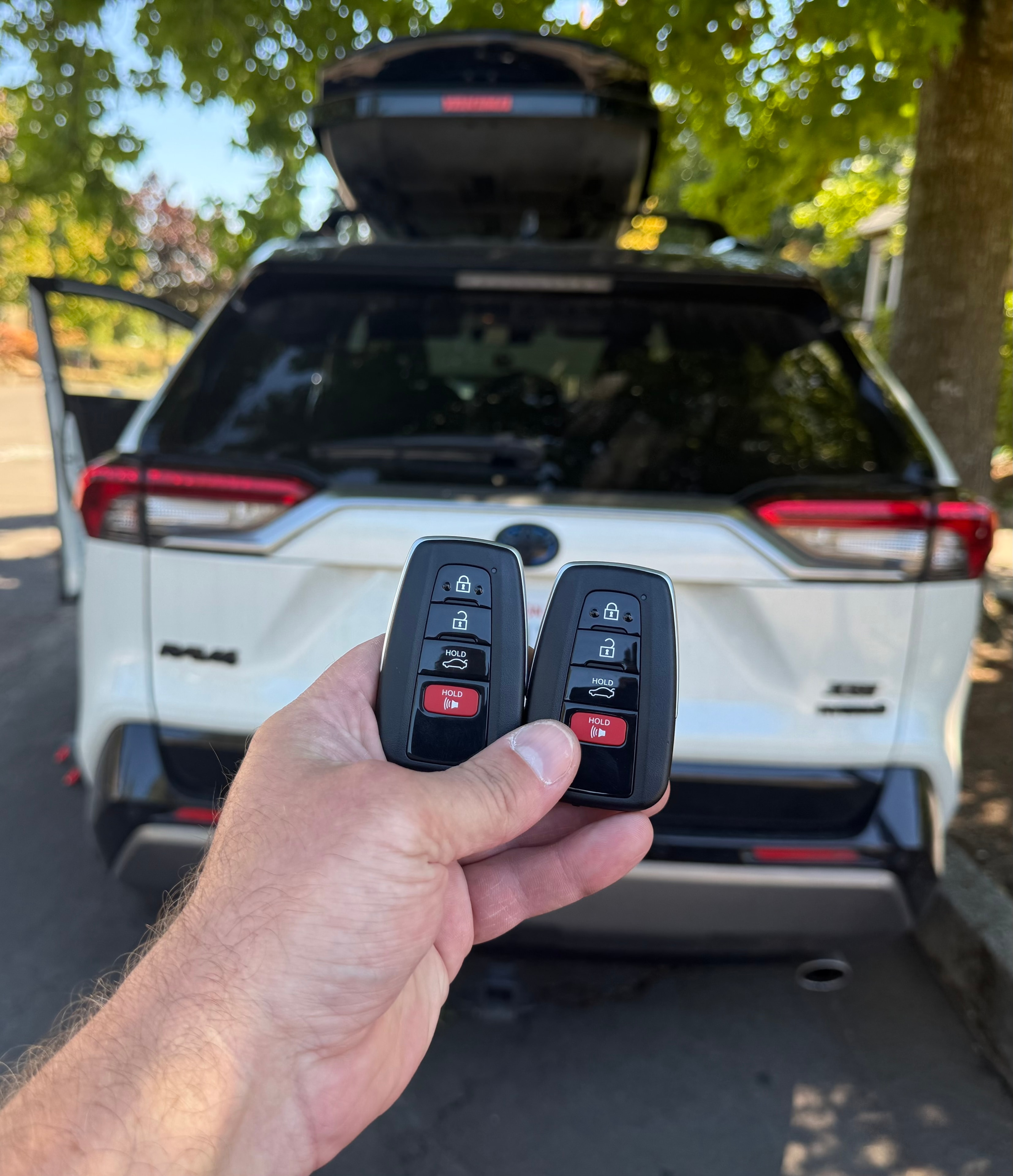
A smart key does not need to be inserted into anything. The vehicle continuously broadcasts a low-frequency signal. When the smart key is within range (typically 3–5 feet), it responds with an encrypted code. The car recognizes the code, unlocks the doors, and allows push-button starting.
How to identify one: No metal blade visible (though most have an emergency blade hidden inside for manual door entry). Your car has a push-button start instead of an ignition cylinder.
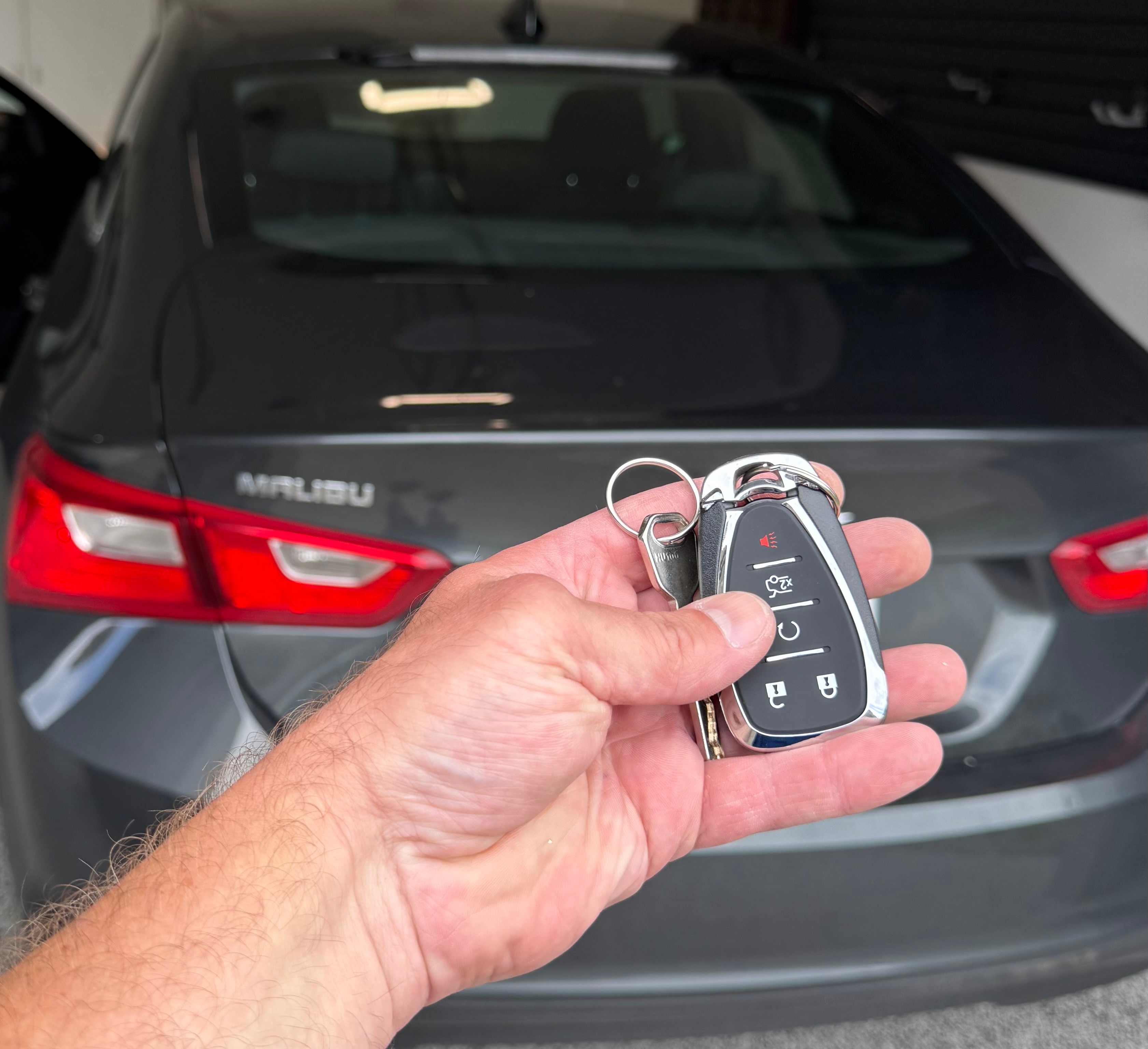
Common vehicles: Most vehicles from 2012 onward. Toyota, Honda, Subaru, Nissan, Ford, Chevrolet, Dodge — virtually every manufacturer now uses smart keys on newer models.
Replacement process: The most complex of all key types. Requires direct ECU communication to enroll the new fob. On some vehicles, this involves a PIN code extraction or IMMO reset. We use Autel and Lonsdor programmers for this.
Why Does This Matter for Replacement?
The more sophisticated the key technology, the more time-consuming and involved replacement becomes. Here is a quick comparison:
| Key Type | Programming Required | Battery | Complexity |
|---|---|---|---|
| Basic metal key | No | No | Minimal |
| Transponder key | Yes | No | Moderate |
| Remote head key | Yes (2 steps) | Yes | Moderate |
| Flip key | Yes (2 steps) | Yes | Moderate |
| Smart key | Yes (complex) | Yes | High |
How to Find Out What Key Your Car Uses
The easiest way: look at your current key. Does it have buttons? Does the blade fold? Does your car have push-button start?
If you are not sure, call us with your year, make, and model. We can tell you immediately what type of key your vehicle uses and give you an accurate quote.
We Program All Key Types in Vancouver WA
We handle transponder keys, remote head keys, flip keys, and smart fobs for most domestic and import vehicles throughout Vancouver WA and Clark County. Available 24/7.
We serve all of Clark County — Orchards, Hazel Dell, Salmon Creek, Camas, Washougal, Battle Ground, Ridgefield, Mill Plain, Five Corners, Minnehaha, Felida, Hockinson, Brush Prairie, Vancouver Lake, and La Center.
Call or text (360) 524-2649 — we will tell you exactly what your vehicle needs before we arrive.
Related: Key Fob Programming Vancouver WA · Car Key Replacement Vancouver WA · Auto Locksmith Vancouver WA